
WAY – "Who Are You" is a holistic and competency-based learning method designed to foster learners' cognitive, social, and emotional development from early childhood through upper secondary education.
WAY places the question "Who am I?" at the center of learning. It aims to help children discover their identity, nurture their curiosity, and develop their emotional intelligence.

Developing the voice and confidence to share unique perspectives.

Understanding others and building deep, meaningful connections.

Working effectively in teams to solve complex problems.

Breaking boundaries and exploring new imaginative horizons.

Visualizing potential paths and building aspirations for tomorrow.
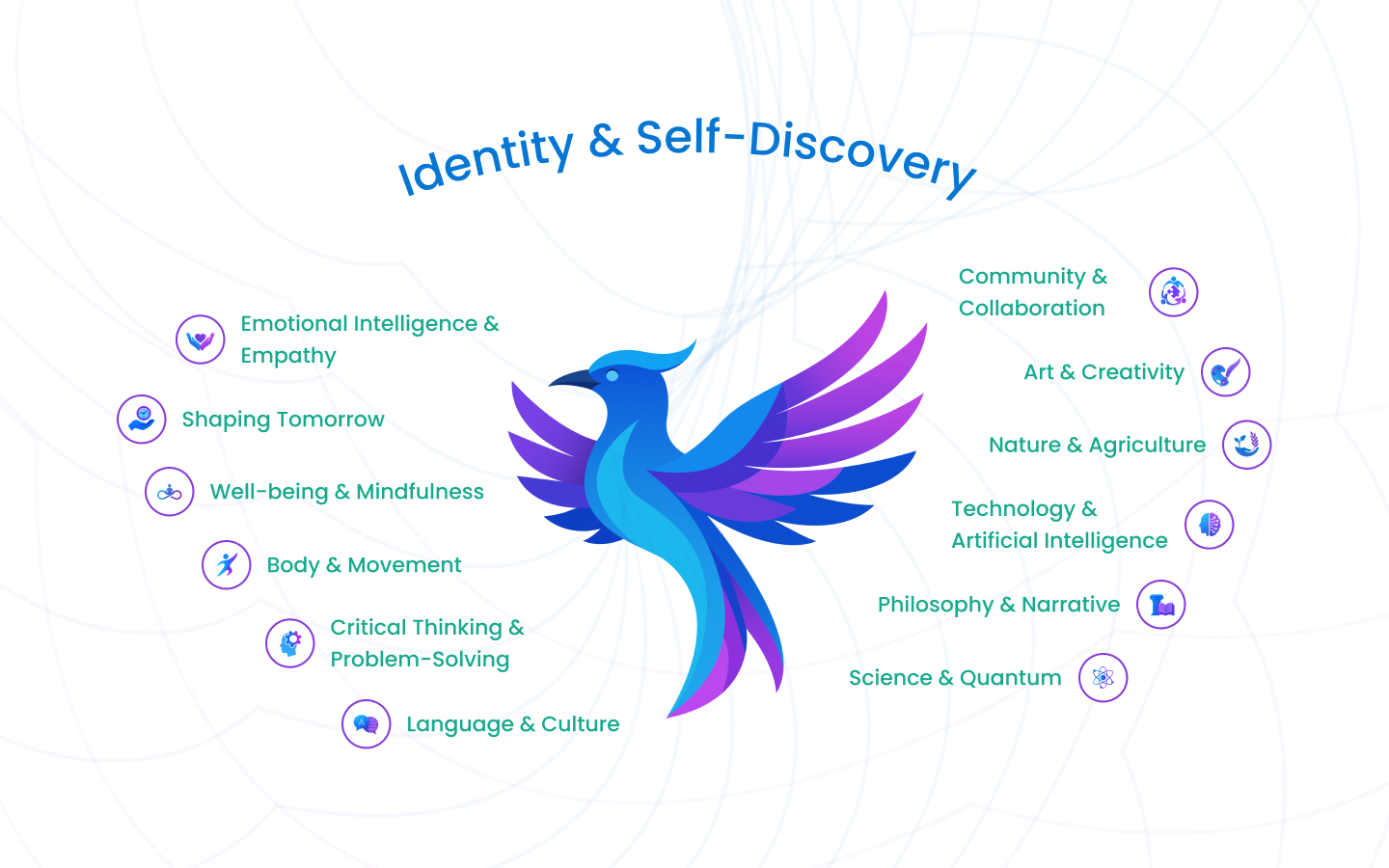
The WAY Learning Ecosystem is built around 12 core social-emotional and cognitive competencies that prepare students for life, not just for exams.
Understand emotions, develop empathy, and build strong relationships.

Prepare for future challenges and opportunities with adaptability.
Foster mental and physical well-being through self-awareness.
Promote physical health, coordination, and active expression.

Analyze information, think critically, and solve complex problems.

Develop communication skills and appreciate cultural diversity.
Work effectively in teams and contribute to the community.

Connect with nature and understand sustainable living practices.
Express creativity through various art forms and imaginative thinking.
Explore philosophical ideas and the power of storytelling.
Understand and leverage technology and AI responsibly.

Investigate scientific principles and the quantum world.
This book presents the conceptual framework, structure, and implementation model of the WAY (Who Are You) methodology.
It serves as a comprehensive guide for educators, schools, and institutions seeking to integrate identity-centered social-emotional learning into academic practice.
Moving from information delivery into identity formation.
A structured methodology that connects self-awareness and emotional regulation.
Connecting the learner's personal world with the educational environment.
Ensuring that social-emotional growth supports academic excellence.
Reflection assessment and data-driven insights for practice.
+40% Academic Achievement
Scientifically examined the relationship between students' academic achievement and their cognitive & social-emotional competencies.
1. Purpose
Measure the impact of the WAY curriculum on academic success.
2. Research Design
Quasi-experimental model with control groups over 6 months.
3. Measurement Tools
SEL scales, standardized tests, and EEG measurements.
4. Findings
Statistically significant difference of over 40% in academic achievement.


